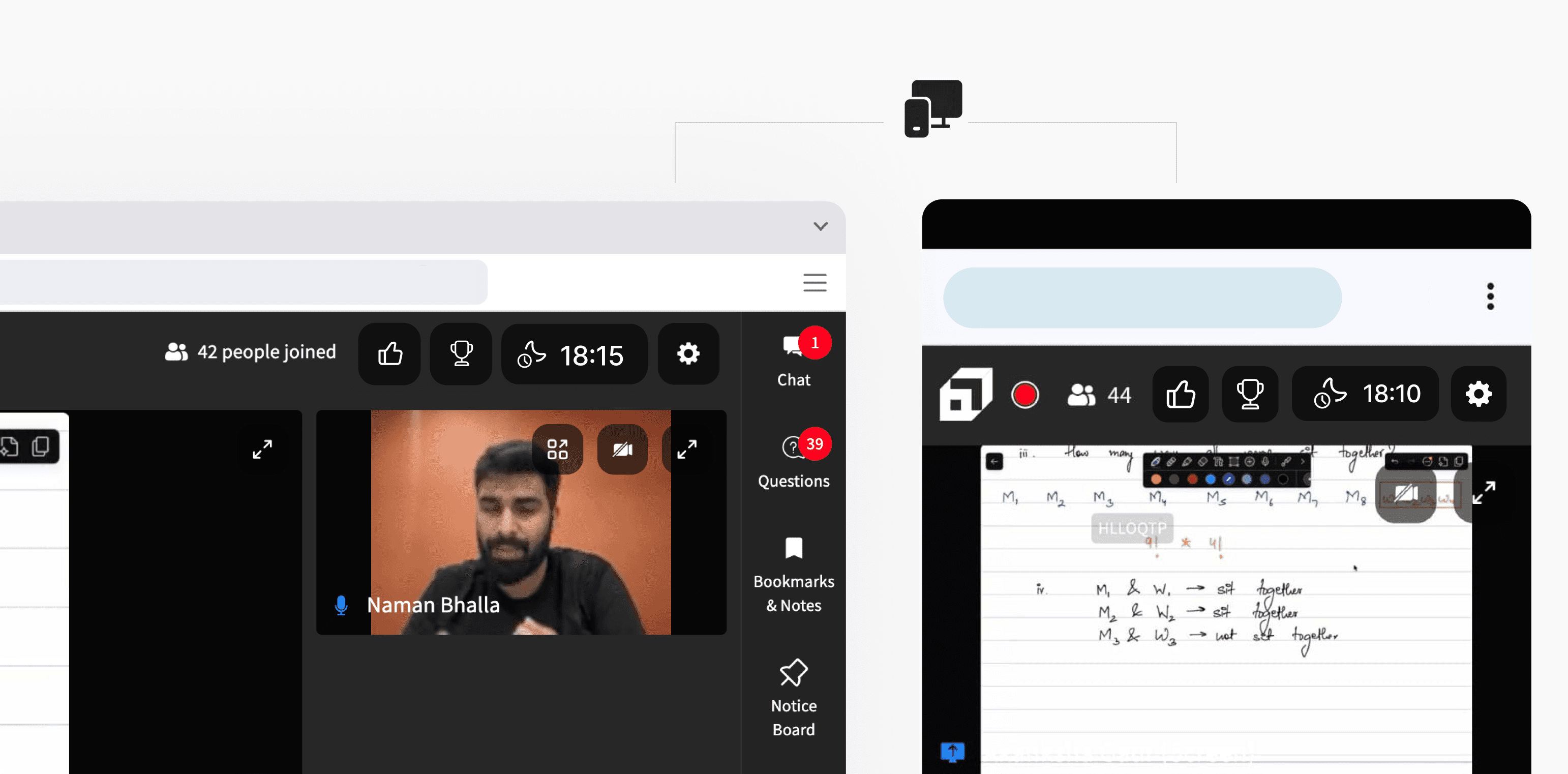
Scaler's live learning environment.
Concentration isn't shaped by a feature alone; attention wanes for a variety of reasons
Concentration isn't shaped by a feature alone; attention wanes for a variety of reasons
External interruptions fall outside boundaries, so I narrowed the scope strictly to controllable interface variables: on-screen distractions.
Rather than simply counting down time, the feature could help protect that time from avoidable distractions. I made one key assumption here: students choosing to use it already had some intention to concentrate. The goal wasn't to force attention, but to support those who had decided to. How might we help students manage avoidable distractions while trying to focus?
External interruptions fall outside boundaries, so I narrowed the scope strictly to controllable interface variables: on-screen distractions.
Rather than simply counting down time, the feature could help protect that time from avoidable distractions. I made one key assumption here: students choosing to use it already had some intention to concentrate. The goal wasn't to force attention, but to support those who had decided to. How might we help students manage avoidable distractions while trying to focus?
Entry point
Because Focus Mode impacts the overall learning session, the top navigation bar serves as the most natural entry point, sitting alongside platforms global system controls.
Entry point
Because Focus Mode impacts the overall learning session, the top navigation bar serves as the most natural entry point, sitting alongside platforms global system controls.
Setting up a focus session
Before starting, users can match the tool to their personal study cadence. Instead of imposing a single rigid approach, the setup overlay balances structured presets—such as Pomodoro-inspired intervals—with customizable durations and flexible distraction-blocking toggles.
Setting up a focus session
Before starting, users can match the tool to their personal study cadence. Instead of imposing a single rigid approach, the setup overlay balances structured presets—such as Pomodoro-inspired intervals—with customizable durations and flexible distraction-blocking toggles.
Choose a duration and configure distraction controls.
Active State
Early prototypes allowed students to adjust session durations mid-stream. However, peer feedback revealed that mid-session editing introduced decision friction, defeating the purpose of a locked commitment. Removing it streamlined the active state to its essentials.
Active State
Early prototypes allowed students to adjust session durations mid-stream. However, peer feedback revealed that mid-session editing introduced decision friction, defeating the purpose of a locked commitment. Removing it streamlined the active state to its essentials.
Additionally, in an interface already displaying multiple time-based metrics, a bare numerical readout (e.g., 20:00) risks confusion with elapsed time or recording status. Pairing the countdown directly with a distinct Focus Mode icon establishes immediate visual clarity.
Cross-Platform Continuity
The timer maintains consistent behavior across desktop and mobile without drawing visual attention away from the instructor's stream.
Responsive layouts preserve identical setup options while adapting to limited screen real estate, remaining platform-agnostic.
For students transitioning between devices during a live class, state synchronization maintains active countdowns without resetting session progress.
Completion
Upon reaching zero, the timer briefly animates to confirm completion before transitioning back to its initial state—ensuring an uninterrupted flow without forcing immediate interaction. Light haptic feedback provides a subtle tactile cue on supported devices.
Completion
Upon reaching zero, the timer briefly animates to confirm completion before transitioning back to its initial state—ensuring an uninterrupted flow without forcing immediate interaction. Light haptic feedback provides a subtle tactile cue on supported devices.
Since attention can't be measured directly, I'd evaluate Focus Mode through activation rate, session completion, repeat usage across future classes, and post-session feedback to understand both adoption and perceived value. One opportunity I'd be excited to explore next is integrating it with Scaler's existing leaderboard, rewarding consistency across classes and encouraging students to build stronger study habits over time.
Conclusion & Learnings
Despite being a relatively small feature, designing Focus Mode uncovered far more edge cases and product decisions than I initially expected. Thinking through different scenarios reinforced how even simple interactions can have wider implications across a live learning session. A few assumptions still remain to be validated with students — most importantly, whether Focus Mode solves a genuine need or is simply a nice-to-have.
Thankyou :)
Conclusion & Learnings
Despite being a relatively small feature, designing Focus Mode uncovered far more edge cases and product decisions than I initially expected. Thinking through different scenarios reinforced how even simple interactions can have wider implications across a live learning session. A few assumptions still remain to be validated with students — most importantly, whether Focus Mode solves a genuine need or is simply a nice-to-have.
Thankyou :)