
Team
Independent Design Challenge

Goal
Design an appointment scheduling system for clinics and medical practices across France and Germany that simplifies management for staff while creating a seamless, high-trust booking process for patients.
Assumptions
The business opportunity, pricing model, and monetization strategy were pre-validated, with leadership approving investment in the product initiative. The scheduling system integrates into HRS’s existing clinic management ecosystem, focusing on strategy definition and execution delivery.
Initial Research & Scoping
Before setting product direction, research focused on mapping how scheduling operates within clinical settings.

Although patients are external-facing users, operational success heavily depended on front-desk staff adoption. This informed a core strategic decision for the MVP: I chose to prioritize operational efficiency first, while ensuring patients encounter clarity and transparency during booking. Instead of treating all personas equally, I centered execution around front-desk teams—the user group with the highest workflow frequency, heaviest operational burden, and strongest impact on product retention.

Prioritisation table & Criterias
Representative User
To anchor the solution in real-world constraints, meet Claire—a front-desk coordinator at a mid-sized clinic. She represents the high-frequency operational user who manages schedules, cancellations, walk-ins, and daily disruptions. Her primary goal is simple: maintain control during peak clinic hours without extra cognitive load. To work within the 8-hour constraint, I leveraged AI tools to rapidly translate these operational needs into product concepts.

Leveraging AI.
Setting up the Scenario

Supporting multi-location networks and shared practitioner rosters required a flexible central view. The dashboard provides instant site-switching and multi-doctor filtering directly from the interface, giving front-desk staff complete visibility over daily capacity.

View and manage schedules
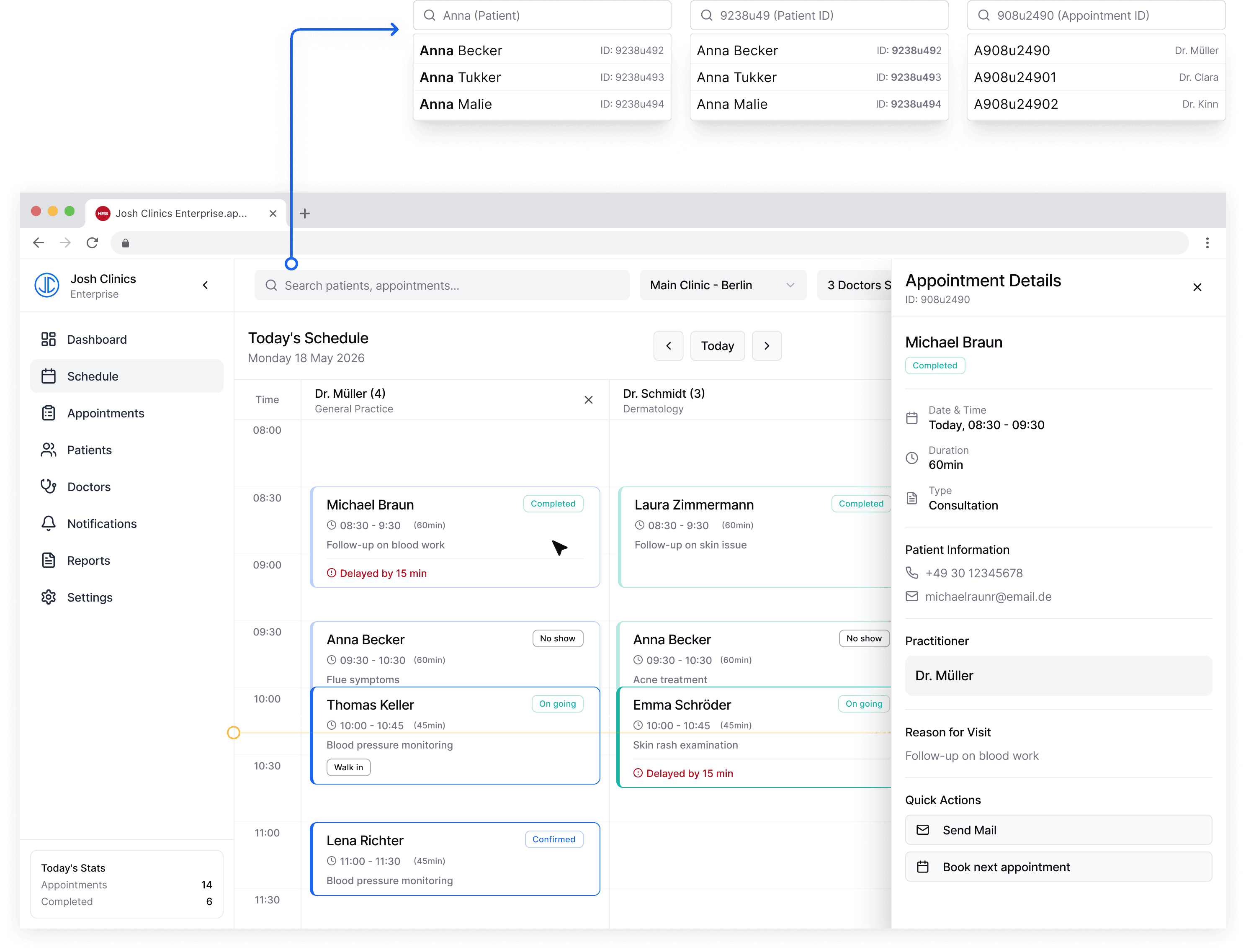
Patients coming into the clinic represent diverse literacy levels and backgrounds, making name-only lookups prone to error. The global search supports multi-attribute querying—by Name, Patient ID, or Appointment ID—for instant recognition. Clicking any card slides out a contextual drawer, allowing staff to review details and trigger quick actions without losing their place on the schedule.
Search & Explore
To prevent human error during busy clinic hours, actions aren't static. The side-drawer evaluates the appointment state to present distinct action sets—eliminating impossible or invalid workflows (like canceling a consult that is already ongoing).

Drawer States
Beyond viewing existing bookings, creating new appointments—especially for walk-ins or urgent requests—demands minimum interaction cost. The creation modal streamlines data entry by proactively suggesting open time windows and running real-time availability checks as practitioner and duration fields are populated.

Edge Cases and Scenarios
Localisation went beyond simply translating the interface into French and German—accounting for 24-hour time formats, DD/MM/YYYY dates, Monday-first calendars, and flexible layouts built to accommodate text expansion. To demonstrate this, I adapted the interface using French text. (And now I know: “C’est joli” means “That’s lovely” in French! 🇫🇷)

Das ist schön
Measuring Success & Impact
As a new product initiative with no pre-existing benchmarks, the immediate focus is establishing baseline operational metrics. These initial data points will serve as the benchmark to validate hypotheses, measure workflow improvements, and guide future product iterations.

Looking ahead
What if clinic operations could actively adapt to daily friction instead of just tracking it? Integrating ambient AI offers a clear path to reducing administrative load and boosting clinic productivity. Desktop voice commands give front-desk staff a hands-free way to execute rapid lookups and handle walk-in bookings during peak rush hours. At the same time, predictive AI models can analyze consultation durations as they happen—forecasting doctor delays early so staff can adjust schedules proactively and keep patients informed before bottlenecks compound.Thank you!